
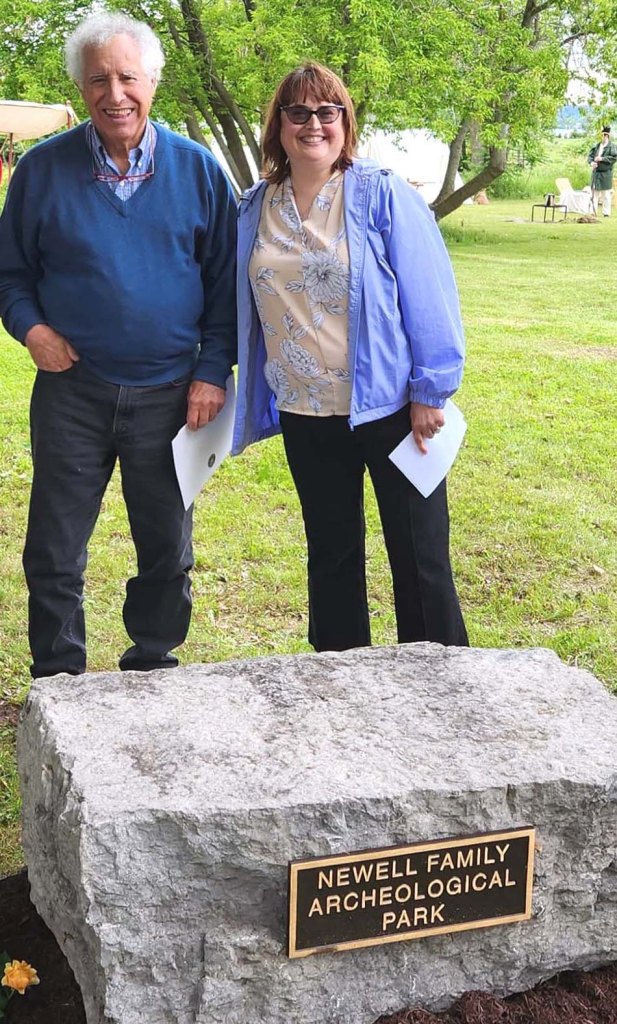
Allan P. Newell with City Historian Julie Madlin
On June 17, 2023, the Fort La Presentation Association had the great pleasure to dedicate the Newell Family Archeological Park on Van Rensselaer Point, site of the fort established there in 1749 by French Sulpician priest Francois Picquet.
The Newell family has long been important to Ogdensburg and its history stretching back to 1903, when the family took a near bankrupt company and began manufacturing curtain rods. Over more than a century, the company became Newell Rubbermaid, Inc., a global marketer of consumer and commercial products such as Rubbermaid, Sharpie, Paper Mate and more.
Present for the dedication was Allan P. Newell, a 1964 graduate of Ogdensburg Free Academy, a longtime Northern New York philanthropist and “a true unsung hero for the Fort La Presentation Association since we first organized more than three decades ago,” association President Barbara O’Keefe said at the dedication.
“When our organization launched its seven-year battle with Exxon Mobil to clean up the extensive contamination on the property, Allan Newell was one of the few people who believed in what we were doing and was willing to donate generously to help our effort,” O’Keefe said.
“Allan recognized long before most people that priceless historical relics from North America’s rich colonial history are buried on Van Rensselaer/Lighthouse Point,” she said. “Thanks to his generosity, we will be able to recover, preserve and interpret for future generations some of these artifacts from five important periods in Ogdensburg’s very rich cultural heritage which are still buried on Van Rensselaer Point.”
City Historian Julie Madlin, president of the Ogdensburg History Museum, also spoke at the dedication, saying that few families have played such an important role in preserving the history of the community. She said that when a small group of volunteers came together to form the Fort La Presentation Association in the 1980s and the 1990s, Allan P. Newell was one of the first major contributors to their efforts to preserve the history of Lighthouse Point, Fort La Presentation and the area’s role in the colonial battles that shaped North America.
“Over the past four decades Allan Newell has always been there, not just because he recognizes the importance of preserving our past, but because it’s the kind of man he is. It’s also part of his heritage, part of his family’s history, and a role that generations of the Newells have played for over a century in Ogdensburg,” said Madlin.
Allan P. Newell served in the U.S. Navy during the Vietnam era. He co-founded and remains the president of the Sweetgrass Foundation which has provided grants to numerous North Country organizations including the Frederic Remington Art Museum, the Ogdensburg Public Library, the Wild Center in Tupper Lake, SUNY Potsdam, St. Lawrence University, Clarkson University, SUNY Canton, Pickens Hall in Heuvelton, Traditional Arts in Upstate New York, and the Silas Wright Museum in Canton.
“As city historian I have been the recipient of a Sweetgrass grant. I am just scratching the surface of all the groups and organizations he has helped when they have needed assistance,” Madlin said.
“As a member of the board of directors of Newell Rubbermaid, Allan P. Newell never forgot the community where his family’s company started. His uncle, W. Allan Newell, a former city mayor and New York State assemblyman, also understood the importance of the place where we are standing today. Mr. Newell was a member of the state historical society who did a great deal of research on Fort La Presentation and its role in the colonial wars that shaped North American history.
“In 1955, when he learned that the New York Power Authority intended to dig up part of what we now call Chimney Island, he led an effort to preserve its history. He enlisted the assistance of Franklin R. Little, publisher of the Ogdensburg Journal, and personally contacted Robert Moses, chairman of the New York Power Authority, who oversaw construction of the Seaway.
“He pleaded that they find a way to preserve the archeological remains of Fort de Levis, the French fortress that once stood in the way of Sir Jeffrey Amherst’s 12,000 British and colonial forces that were sweeping down the St. Lawrence River in 1760 to conquer Montreal and New France. A small group of 300 brave French soldiers and French Canadians made a heroic stand at Fort de Levis, delaying the British invasion for almost two weeks in a vain hope that the King of France would send reinforcements to save New France from British conquest.
“W. Allan Newell and Robert Moses enlisted the assistance of the commanding general of Fort Drum who sent a detachment of soldiers with minesweepers to search the island for archeological remains of that ‘Alamo’ of the French forces that tried to save New France. He asked for volunteers to come with him to Chimney Island to search for the archeological remains of Fort de Levis and those French heroes who held off a British and colonial army that outnumbered them 40 to one.
“In fact, he attended a meeting of the Ogdensburg Rotary Club and asked them to come out to the island with him to dig for relics in the places where the Army had planted flags, showing where their mine detectors had found metal buried beneath the ground. Unfortunately, despite their best efforts, all the search turned up was one cannonball, some rusty hand cut nails and a piece of the hinge of the French fort,” Madlin said.
She said that Allan P. Newell knows that story very well. “That’s why he helped the Fort La Presentation Association buy the property where we are standing today. Mr. Newell understands that just five feet underground, all throughout this area, there is a buried treasure. It may not be gold and jewels. But its historical value is priceless. We are standing today on hallowed ground. You probably don’t realize it but we are standing where three major wars were fought.”
Madlin said that when the railroad built its facilities on Lighthouse Point, it brought in five feet of fill. “That effectively created an archeological treasure chest of buried historical relics just beneath where we are standing today. Buried beneath us are the remains from the French and Indian War and Fort La Presentation. Standing beneath us once stood a British Fort, Fort Oswegatchie which sent British and Native American raiding parties to the Mohawk Valley during the American Revolutionary War.
“The first American pioneers arrived here in 1796 and American troops fought here during the War of 1812. Today we are dedicating the Newell Family Archeological Park because we want to preserve our community, our nation and North America’s colonial history and the role our city played in the major events of three centuries of American history. We would not be able to do it without Allan P. Newell and his family’s efforts to preserve our history almost three quarters of a century ago.
“He realized that we could do much better than those soldiers with minesweepers did so many years ago. We can use modern archeological methods to discover our history and preserve it in the way that W. Allan Newell wanted the Power Authority to do when he fought for a dig back in 1955. Thanks to Allan Newell, Ogdensburg has a rare opportunity to preserve our history the right way and to teach future generations that history didn’t happen somewhere else. It happened right here and it’s worth preserving.
“So thank you W. Allan Newell for your efforts and thank you Allan P. Newell. Thanks to both of you we will get it right this time!” Madlin said.
 fort1749.org